

Disclosure: This article contains affiliate links. If you purchase through links in this article, we may earn a commission at no additional cost to you.
Finding practical laundry room organization ideas can make everyday laundry much easier. Detergent bottles, cleaning supplies, laundry baskets, stain removers, and small accessories can quickly make a laundry room feel crowded and difficult to use.
The good news is that you do not need a large laundry room or an expensive storage system to create a more functional space. The goal is to give frequently used items a clear home and make the most of the space you already have.
In this guide, you’ll find 15 simple laundry room organization ideas covering storage zones, shelves, baskets, cleaning supplies, small accessories, door storage, labeling, and easy maintenance.
In this guide:
- Declutter the Laundry Room First
- Create Dedicated Storage Zones
- Use Shelves to Maximize Vertical Space
- Add Matching Storage Bins
- Organize Laundry Supplies by Category
- Keep Everyday Supplies Within Easy Reach
- Use a Slim Cart for Narrow Spaces
- Create a Simple Folding Station
- Keep Cleaning Supplies Together
- Use the Back of the Door for Storage
- Organize Small Laundry Accessories
- Label Laundry Room Storage Zones
- Make Narrow Spaces Work
- Leave Some Open Space
- Create a Simple Weekly Reset Routine
1. Laundry Room Organization Ideas: Declutter the Laundry Room First
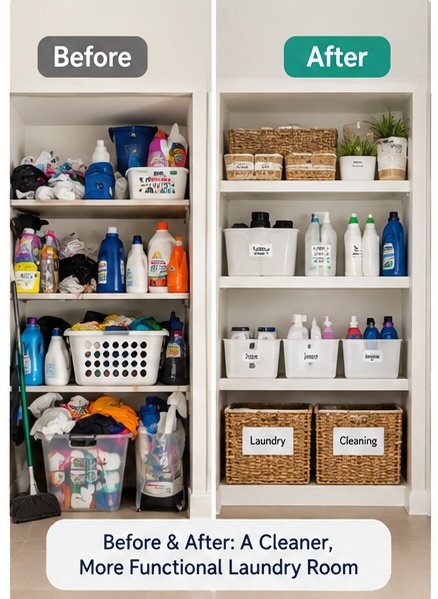
One of the easiest ways to improve a laundry room is to start by removing items that do not need to be there.
Take everything out of the main storage areas and sort the items into simple groups. Check for empty containers, duplicate products, old cleaning supplies, and things that belong somewhere else.
Starting with less clutter gives you a much better idea of how much storage space you actually need.
You can also use this opportunity to group similar products together before putting anything back.
2. Create Dedicated Storage Zones
A laundry room becomes easier to use when different types of supplies have their own areas.
For example, you can create separate zones for detergent, stain removal products, cleaning supplies, laundry accessories, towels, and extra household supplies.
Clear zones make it easier to find what you need without searching through every shelf or cabinet.
They also make it easier for other family members to return items to the correct location.
3. Use Shelves to Maximize Vertical Space
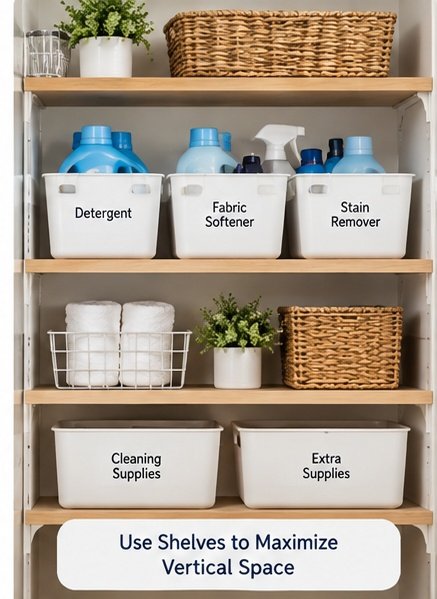
If your laundry room has limited floor space, look upward.
Wall shelves can turn unused vertical space into useful storage for detergent, towels, baskets, cleaning products, and household supplies.
Place frequently used items at a comfortable height and reserve higher shelves for backup supplies or items you do not use every day.
Before installing shelves, check the wall structure and follow the manufacturer’s installation instructions to make sure the shelving is appropriate for the intended load.
4. Add Matching Storage Bins
Storage bins can help make open shelving look more organized while keeping smaller items contained.
Use bins for categories such as extra laundry supplies, cleaning cloths, stain-treatment products, or household accessories.
Choose containers that fit your shelves and are easy to remove when you need something.
There is no need to make every container identical. The most important thing is that each bin has a clear purpose.
If you are also organizing storage bins in other areas of your home, you may find our guide on how to label storage bins helpful.
5. Organize Laundry Supplies by Category
Instead of placing all laundry products together, separate them into practical categories.
For example, detergent and fabric care products can stay together, while stain removers and cleaning products can have their own area.
Small accessories such as clothespins, dryer balls, measuring cups, and laundry clips can be stored separately from large bottles.
This simple approach reduces visual clutter and makes it easier to see what you already have.
6. Keep Everyday Supplies Within Easy Reach
Think about which products you use every week and keep those items in the easiest-to-reach locations.
Detergent, stain remover, laundry baskets, and other frequently used supplies should not require reaching behind several other containers.
Less frequently used backup products can go higher on a shelf or toward the back of a cabinet.
Organizing by frequency of use can make the laundry routine feel much more efficient.
7. Use a Slim Cart for Narrow Spaces
Narrow gaps can become useful storage areas in a small laundry room.
A slim rolling cart can fit between appliances, cabinets, or walls and provide additional space for bottles and smaller supplies.
Because the cart can be moved, it can also make cleaning around the laundry machines easier.
Measure the available space carefully before purchasing a cart and make sure there is enough clearance for doors, drawers, and appliances to operate normally.
8. Create a Simple Folding Station
If you have enough surface space, create a small area for folding clothes.
A countertop above front-loading machines can provide a convenient folding surface, while a nearby shelf can hold baskets or folded towels.
The goal is not to create a large laundry workspace. Even a small, dedicated surface can help keep clean clothes from accumulating in random places.
Keep the folding area as clear as possible so it remains useful when laundry day arrives.
9. Keep Cleaning Supplies Together
Laundry rooms often become storage areas for more than laundry products.
Cleaning sprays, microfiber cloths, brushes, sponges, and other household supplies can easily become mixed with detergent and laundry accessories.
Create a dedicated cleaning-supply zone so these products are easy to find and return.
Keep household chemicals stored according to their labels and manufacturer instructions, especially if children or pets are in the home.
10. Use the Back of the Door for Storage
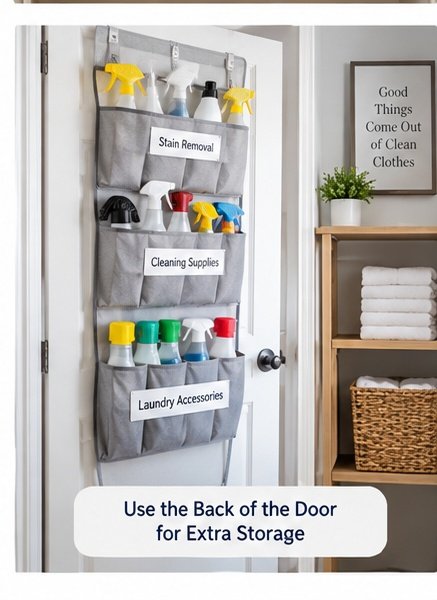
The back of a laundry room door can provide valuable storage space without taking up floor area.
An over-the-door organizer can hold smaller bottles, stain-removal products, cleaning accessories, cloths, or other lightweight supplies.
This is particularly useful in small laundry rooms where every bit of available space matters.
Before installing a door organizer, check that the door can still close properly and that the organizer is suitable for the door type and weight of the items you plan to store.
11. Organize Small Laundry Accessories
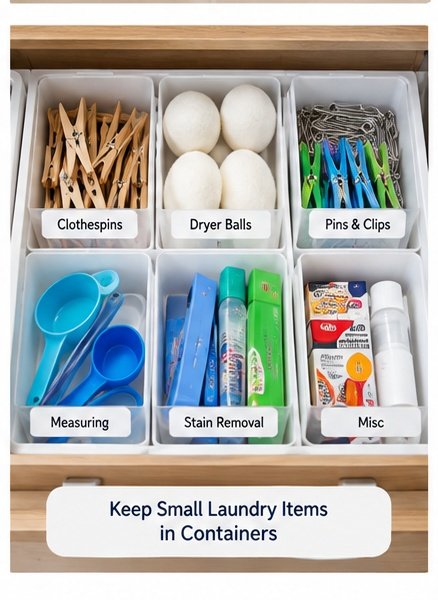
Small laundry accessories can quickly become difficult to find when they are stored loose on a shelf.
Clothespins, dryer balls, measuring tools, laundry clips, and stain-treatment accessories can be placed in small containers or divided compartments.
Use shallow containers for items you reach for frequently and deeper containers for larger accessories.
The goal is to prevent small items from spreading across the entire laundry room.
12. Label Laundry Room Storage Zones
Labels can make an organization system easier for everyone in the household to understand.
Instead of labeling every individual product, consider labeling the storage zones themselves.
Simple labels such as Detergent, Cleaning Supplies, Stain Removal, Laundry Accessories, or Extra Supplies can make the system easier to maintain.
A Bluetooth label maker can be especially useful when you want consistent labels across multiple areas of your home.
Want a simpler labeling system?
A Bluetooth label maker can help create consistent labels for laundry rooms, storage bins, pantries, kitchen drawers, and other shared spaces.
See how to use a Bluetooth label maker for home organization →
13. Make Narrow Spaces Work
Small laundry rooms often have awkward gaps that are too narrow for traditional storage furniture.
Instead of leaving these areas unused, consider slim shelves, narrow carts, or small containers that fit the available space.
Measure the width, depth, and height before buying anything so you can make sure the storage solution will work without blocking doors or appliances.
Even a narrow storage area can become useful when it has a specific purpose.
14. Leave Some Open Space
One common mistake when organizing a laundry room is filling every shelf and cabinet completely.
Some empty space makes it easier to put products away and gives you room when you purchase replacement supplies.
It also makes the room feel less crowded and makes frequently used items easier to reach.
A practical laundry room does not need every inch of space to be occupied.
15. Create a Simple Weekly Reset Routine
The final step is creating a system that is easy to maintain.
Once a week, take a few minutes to return supplies to their designated zones, remove empty containers, and check whether any category is becoming overcrowded.
If something repeatedly ends up outside its assigned area, consider whether the storage location is actually convenient enough.
A good organization system should work with your everyday habits rather than forcing you to constantly rearrange things.
Final Thoughts
The best laundry room organization ideas do not require a large room or a complicated storage system.
Start by removing unnecessary items, create clear zones, use vertical and door space, and keep frequently used supplies within easy reach.
Storage bins, shelves, laundry baskets, small containers, and simple labels can help turn a crowded laundry room into a space that is easier to use and maintain.
Most importantly, leave enough room for the system to remain practical. Organization should make laundry easier, not create another chore.
If you are continuing to organize other areas of your home, you can also explore our guides on how to label storage bins, under sink organization ideas, and junk drawer organization ideas.
[…] For more practical organization ideas around clothing care, see our laundry room organization ideas. […]
[…] For more ideas on keeping clothing-care areas organized, see our laundry room organization ideas. […]
[…] you also want to make your laundry routine more efficient, see our Laundry Room Organization Ideas guide for practical ways to keep clothing-care supplies organized at […]
[…] Laundry room organization ideas for keeping laundry supplies and clean items easier to manage. […]