

Disclosure: This article contains affiliate links. If you purchase through links in this article, we may earn a commission at no additional cost to you.
Finding practical junk drawer organization ideas can make a surprisingly big difference in a busy kitchen. Small tools, batteries, cords, pens, scissors, tape, and miscellaneous items can quickly turn one drawer into a frustrating pile of clutter.
The good news is that you do not need a complicated storage system to fix it. The goal is to create simple zones that make everyday items easy to find and easy to put back.
In this guide, you’ll find 15 practical ways to organize a junk drawer, including simple sorting methods, drawer organizers, small-item storage, cable organization, labeling, and easy maintenance habits.
In this guide:
- Empty the Drawer Completely
- Remove Things That Do Not Belong
- Group Similar Items Together
- Create Simple Storage Zones
- Use Small Drawer Organizer Trays
- Try Adjustable Drawer Dividers
- Keep Everyday Items in Front
- Create a Small Catch-All Zone
- Give Batteries Their Own Section
- Keep Cords and Chargers Together
- Keep Small Tools Together
- Use Labels for Drawer Zones
- Make Awkward Drawer Space Work
- Leave Some Empty Space
- Create a Simple Reset Routine
1. Junk Drawer Organization Ideas: Empty the Drawer Completely
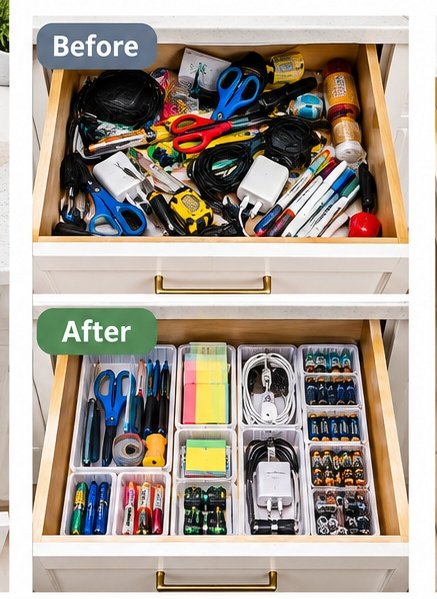
The easiest way to organize a junk drawer is to start with an empty drawer.
Take everything out and place the items on a nearby counter or table. Seeing everything at once makes it much easier to understand what has accumulated inside the drawer.
Do not try to organize items while they are still inside the drawer. Starting with an empty space gives you a clean starting point and makes the rest of the process much easier.
2. Remove Things That Do Not Belong
Once everything is out, separate the items that do not actually belong in the drawer.
You may find old receipts, empty packaging, duplicate tools, broken accessories, or items that belong somewhere else in the house.
Move those items before deciding how to organize the things that remain.
A junk drawer works best when it has a clear purpose. It does not need to become a storage location for everything you do not know where to put.
3. Group Similar Items Together
After removing unnecessary items, create simple groups.
For example, you might have groups for pens and markers, scissors and tape, batteries, small tools, cords, office supplies, and miscellaneous household items.
Do not create too many categories. The goal is to make the drawer easier to use, not to create a complicated filing system.
Start with broad categories and divide them further only when necessary.
4. Create Simple Storage Zones
Once you know what you want to keep, decide where each category should live.
A useful arrangement is to keep frequently used items near the front of the drawer and less frequently used items toward the back.
You can also place categories next to related items. For example, scissors can sit near tape, while batteries can have their own separate section.
Clear zones make it much easier for everyone in the household to return items to the correct place.
5. Use Small Drawer Organizer Trays
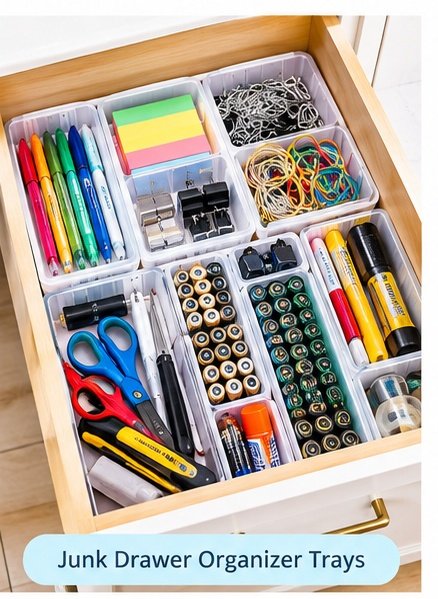
Small organizer trays are one of the simplest ways to prevent a junk drawer from becoming a single pile of objects.
Instead of letting pens, scissors, batteries, clips, and other items mix together, separate them into individual compartments.
Choose tray sizes based on the items you actually own rather than filling the drawer with containers simply because they fit.
Clear or open organizers can also make small items easier to see without having to move everything around.
6. Try Adjustable Drawer Dividers
Not every drawer has the same dimensions, so fixed-size organizers are not always the best solution.
Adjustable dividers allow you to create compartments that match the size and shape of your drawer.
They can be especially useful when you have several categories with different amounts of storage space.
Before purchasing dividers, measure the inside dimensions of the drawer and check how the drawer opens and closes.
7. Keep Everyday Items in Front
One simple rule can make a junk drawer much easier to use: keep the things you reach for most often in the easiest-to-access areas.
Scissors, pens, tape, and other frequently used items can stay toward the front.
Backup batteries, specialty tools, and less frequently used accessories can be placed farther back.
This small change can reduce the amount of searching you do every time you open the drawer.
8. Create a Small Catch-All Zone
A junk drawer does not need to be completely rigid.
There will always be small household items that do not fit neatly into an existing category.
Instead of allowing these items to spread throughout the drawer, create one small catch-all section.
Keep this area intentionally small. If it starts overflowing, that is a useful signal that some items need to be relocated or removed.
9. Give Batteries Their Own Section
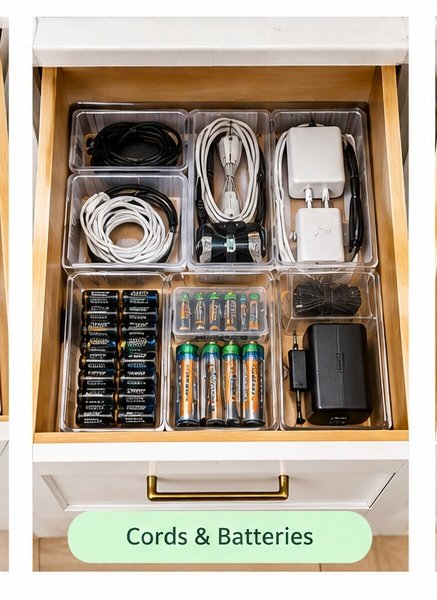
Batteries can easily become mixed with other small objects, making them difficult to find when you need them.
Give batteries a dedicated compartment and separate them from loose metal objects whenever possible.
You can organize them by size, such as AA, AAA, C, or D, so you can quickly identify what you have available.
For battery safety and storage guidance, follow the recommendations provided by the battery manufacturer.
10. Keep Cords and Chargers Together
Small cords and chargers can quickly take over a drawer if they are not contained.
Group similar cables together and use small ties or reusable straps to keep them from becoming tangled.
If you have chargers that belong to specific devices, consider keeping each charger and its cable together.
A dedicated compartment can also make it easier to see which cables you actually use and which ones can be relocated elsewhere.
11. Keep Small Tools Together
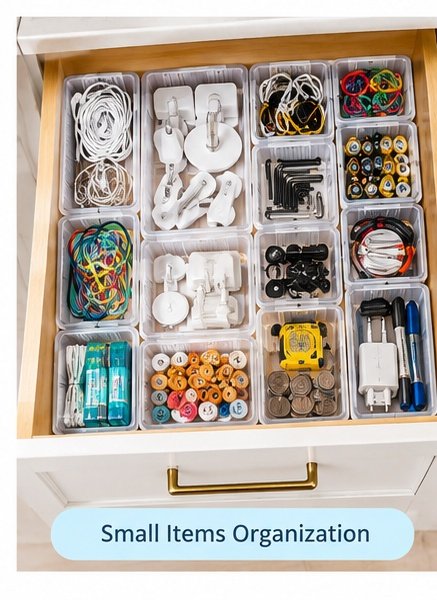
Small household tools are useful in a junk drawer, but they should have a defined space.
Items such as small screwdrivers, measuring tools, utility accessories, or compact household tools can be grouped together.
Use a deeper compartment for taller tools and shallow compartments for smaller accessories.
This keeps tools from rolling underneath other items and makes them easier to grab when needed.
12. Use Labels for Drawer Zones
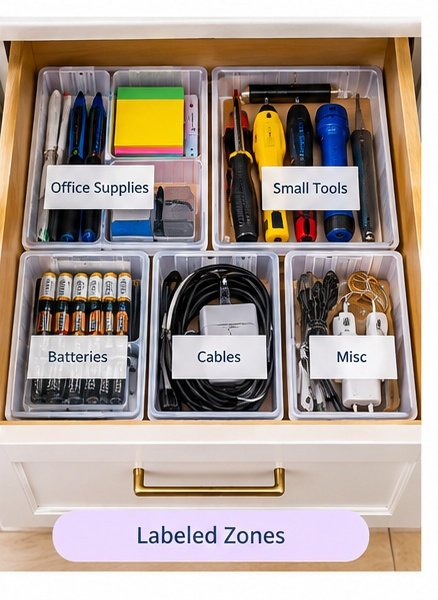
Labels can be useful when several people share the same kitchen.
Instead of labeling every individual item, label the storage zones themselves.
Simple labels such as Office Supplies, Batteries, Tools, or Cables can make the system easier for everyone to understand.
A Bluetooth label maker can also help create consistent labels throughout different areas of your home.
Want a simpler labeling system?
A Bluetooth label maker can help create consistent labels for kitchen drawers, storage bins, pantries, home offices, and other shared spaces.
See how to use a Bluetooth label maker for home organization →
13. Make Awkward Drawer Space Work
Not every junk drawer has a convenient rectangular shape.
Some drawers are unusually shallow, narrow, or divided by internal hardware.
Instead of trying to force one large organizer into the space, combine several smaller containers or adjustable dividers.
Small containers can often make better use of awkward corners while still keeping individual categories separated.
The goal is to make the available space functional rather than trying to make every section look identical.
14. Leave Some Empty Space
One of the most common mistakes when organizing a junk drawer is filling every available inch.
A little empty space makes it easier to put items away and prevents the drawer from becoming cluttered again.
Leave enough room around frequently used categories so that items can be returned without carefully rearranging the entire drawer.
A slightly less full drawer is often easier to maintain than a perfectly packed one.
15. Create a Simple Reset Routine
The final step is creating a system you can actually maintain.
Whenever you use something from the drawer, return it to its designated zone instead of placing it wherever there is an empty spot.
Every few weeks, take a few minutes to remove items that do not belong and check whether any category has become overcrowded.
This small reset can prevent a completely organized drawer from slowly turning back into a junk drawer.
Final Thoughts
The best junk drawer organization ideas are not necessarily complicated. A successful system usually starts with removing unnecessary items, grouping similar things together, and giving each category a clear home.
Small organizer trays, adjustable dividers, dedicated battery and cable sections, and simple labels can make the drawer easier to use without requiring a major storage project.
Most importantly, leave enough space for the system to remain practical. Organization should make everyday life easier, not create another chore.
If you are working on other areas of your home, you can continue the same approach with our guides on how to label storage bins, home office organization ideas, and under sink organization ideas.
8
[…] If you are continuing to organize other areas of your home, you can also explore our guides on how to label storage bins, under sink organization ideas, and junk drawer organization ideas. […]