

Disclosure: This article contains affiliate links. If you purchase through links in this article, we may earn a commission at no additional cost to you.
A small entryway can become cluttered surprisingly quickly. Shoes collect by the door, bags end up on the floor, and keys seem to disappear just when you need them.
The problem is usually not the size of the space. It is that everyday items do not have a clear place to land when you come home.
These small entryway organization ideas focus on practical problems that make a narrow entryway difficult to maintain, from overflowing shoes to misplaced keys and renter-friendly storage.
Table of Contents
- 1. Give Everyday Shoes a Specific Home
- 2. Choose Slim Storage Instead of Deep Furniture
- 3. Separate Everyday Shoes From Seasonal Shoes
- 4. Create a Key Drop Zone
- 5. Give Mail a Temporary Landing Spot
- 6. Get Bags Off the Floor
- 7. Use Wall Space for Coats
- 8. Give Small Accessories One Container
- 9. Give Each Family Member a Defined Spot
- 10. Make the System Easy for Children to Use
- 11. Use Renter-Friendly Storage
- 12. Check the Door Swing Before Adding Furniture
- 13. Keep the Entryway From Becoming a Storage Room
- 14. Prevent Baskets From Becoming Junk Containers
- 15. Create a Simple Reset Routine
1. Give Everyday Shoes a Specific Home
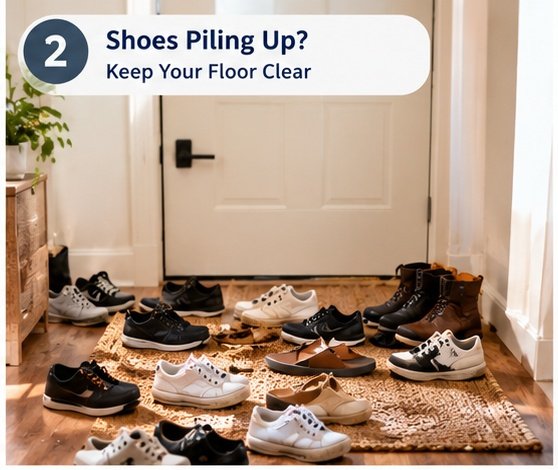
One of the fastest ways for a small entryway to become messy is letting everyone leave shoes wherever there is an empty spot.
Instead, choose one specific location for the shoes used most often. This might be a small shoe rack, a cabinet, or an open shelf near the door.
The goal is not to store every pair of shoes in the entryway. It is to make the easiest choice the organized choice.
2. Choose Slim Storage Instead of Deep Furniture
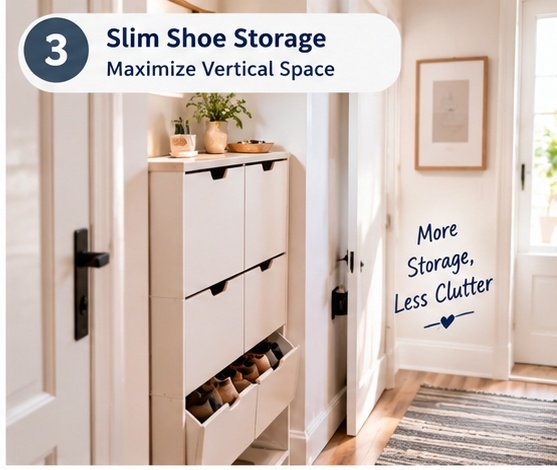
When floor space is limited, a deep storage cabinet can make the entryway feel even narrower.
Measure the available depth before buying furniture and look for a slim shoe cabinet or narrow shelving unit that leaves a comfortable walking path.
A smaller piece that fits the space properly is often more useful than a larger organizer that blocks the main route through the entryway.
3. Separate Everyday Shoes From Seasonal Shoes
Not every pair of shoes needs to live near the front door.
Keep frequently worn shoes within easy reach and move seasonal or occasional footwear to a closet or another storage area.
This simple separation prevents the entryway from becoming a display area for your entire shoe collection.
If your closet also feels crowded, see our guide to small closet organization ideas for additional ways to separate everyday and less frequently used items.
4. Create a Key Drop Zone
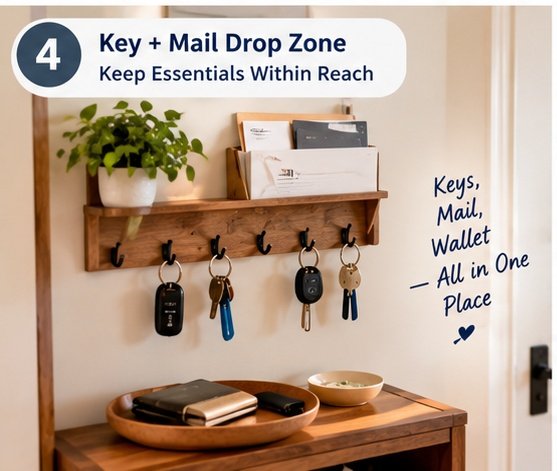
Keys do not need a large storage system. They simply need a consistent landing spot.
A small tray, wall-mounted hook, or compact key holder near the door can work well. Choose one location and make it the place where keys go every time you come home.
If the drop zone is too far from the door, it is much easier to ignore it and leave keys somewhere else.
5. Give Mail a Temporary Landing Spot
Mail often becomes clutter because there is no decision point between the front door and the rest of the house.
Use a small wall pocket, tray, or basket as a temporary mail station. The important word is temporary.
Set a regular time to sort it so the entryway does not become a permanent storage area for unopened envelopes and papers.
6. Get Bags Off the Floor
Handbags, backpacks, and reusable shopping bags can quickly consume valuable floor space in a narrow entryway.
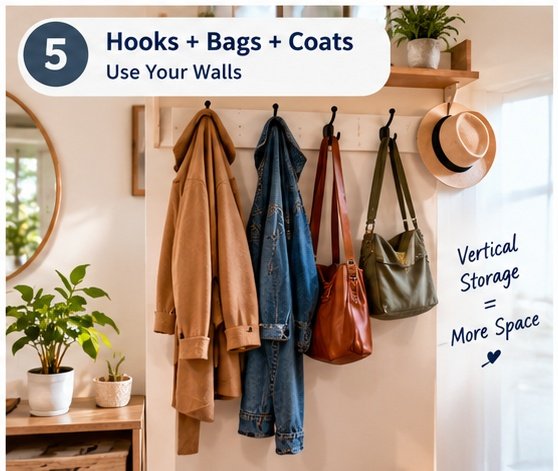
Wall hooks or a short row of hooks can move these items upward and keep the walking area clear.
Keep the hooks close enough to the door that putting a bag away takes only a few seconds.
7. Use Wall Space for Coats
If your entryway has little floor space, look upward.
Hooks can use otherwise empty wall space for jackets, hats, scarves, and lightweight outerwear without adding another large piece of furniture.
However, avoid filling every available hook. Too many coats hanging together can make even an organized wall look crowded.
8. Give Small Accessories One Container
Gloves, sunglasses, dog-walking accessories, umbrellas, and other small items are easy to lose when each item has a different storage location.
Choose one small basket or container for the accessories you regularly use near the door.
Once the container is full, that is a useful signal to remove items that do not belong there.
9. Give Each Family Member a Defined Spot
A shared entryway becomes harder to maintain when everyone uses the same storage area without knowing where their belongings belong.
If space allows, assign a hook, basket, shelf, or small section of the shoe rack to each person.
This does not need to look complicated. Even a simple left-to-right system can reduce the number of items that end up on the floor.
10. Make the System Easy for Children to Use
A storage system only works when the people using it can actually reach and understand it.
For children, lower hooks, open baskets, and easy-access shoe storage may work better than tall cabinets or complicated organizers.
If putting something away takes too many steps, it is more likely to be left beside the door instead.
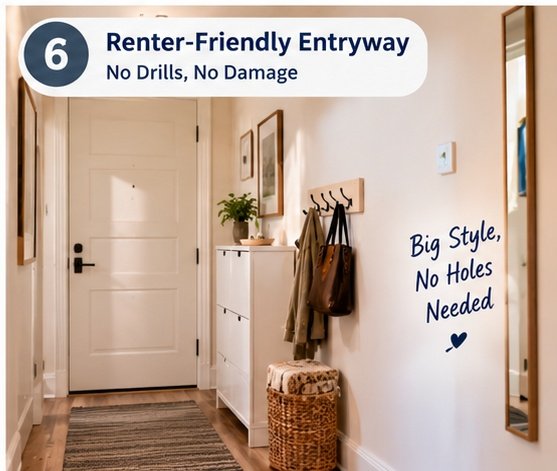
11. Use Renter-Friendly Storage
Renters may not want to drill into walls or permanently change the entryway.
Freestanding shoe racks, over-the-door organizers, removable hooks designed for appropriate surfaces, and small baskets can provide flexible options without requiring permanent installation.
Always check the manufacturer’s instructions and the condition of the surface before using adhesive products.
12. Check the Door Swing Before Adding Furniture
A common mistake in a small entryway is buying storage based only on its dimensions.
Before adding a cabinet, bench, or shelf, open the door fully and consider how people move through the space.
A piece of furniture that technically fits may still make the entryway difficult to use if it interferes with the door or creates a narrow walking path.
13. Keep the Entryway From Becoming a Storage Room
Because the entryway is convenient, it can slowly become a place for items that do not actually belong there.
Packages, sports equipment, shopping bags, boxes, and random household items can easily accumulate near the door.
Use the entryway for things you need when leaving or arriving. Move everything else to its proper storage area.
14. Prevent Baskets From Becoming Junk Containers
Baskets can make a small entryway look organized while hiding a growing pile of unrelated items.
Give each basket a clear purpose. For example, one basket might be for hats and gloves while another is for reusable shopping bags.
If you cannot explain what belongs in a basket, it may be functioning as a junk container rather than an organizer.
If you use labeled containers elsewhere in your home, our guide on how to label storage bins can help you create a more consistent system.
15. Create a Simple Reset Routine
The best small entryway organization ideas are the ones that are easy to maintain after the initial cleanup.
Once or twice a week, take a few minutes to return shoes, bags, keys, mail, and accessories to their assigned locations.
Every few months, remove seasonal items and anything that no longer needs to stay near the door.
A short reset is much easier than waiting until the entire entryway needs to be reorganized from scratch.
Want a More Organized Home Beyond the Entryway?
A simple labeling system can make storage areas easier to find and maintain throughout your home.
Final Thoughts on Small Entryway Organization Ideas
A small entryway does not need more furniture to become more functional. It needs a simple system for the things that arrive there every day.
Start with the biggest source of clutter, whether that is shoes, bags, keys, or mail. Give that category a specific home before adding more storage.
Then use vertical space, keep frequently used items within easy reach, and remove anything that does not belong near the door.
When every everyday item has an obvious place to land, even a narrow entryway can stay organized without requiring constant effort.