

As an Amazon Associate, NooklyGems earns from qualifying purchases.
A refrigerator can look organized on cleaning day and still become chaotic again a few days later.
The problem usually isn’t a lack of storage space. It’s that food doesn’t have a clear home, frequently used items get buried, leftovers disappear behind new groceries, and everyone in the household puts things back differently.
The best refrigerator organization system should do more than make the fridge look nice. It should make food easier to find, make everyday cleanup simpler, and help you use what you already have before buying more.
These 15 refrigerator organization ideas focus on practical problems that make refrigerators difficult to maintain — from crowded shelves and condiment clutter to forgotten leftovers and organizers that don’t fit.
Quick Answer: What Is the Best Way to Organize a Refrigerator?
Start by removing expired or unwanted food, then group similar items into practical zones.
Use clear bins for categories that tend to spread across shelves, a Lazy Susan for small bottles and condiments, stackable containers for leftovers, and simple labels when they genuinely help.
Most importantly, measure your refrigerator before buying organizers. A storage bin that looks useful online can waste space if it is too wide, too tall, or difficult to pull out.
A good system should make the food you use most often visible and easy to reach.
1. Create Refrigerator Zones Instead of Putting Food Anywhere
One of the biggest refrigerator organization mistakes is treating every shelf as general storage.
When there is no system, yogurt ends up beside vegetables, drinks take over an entire shelf, and leftovers get pushed wherever there happens to be room.
Instead, create simple zones based on how you actually use your refrigerator.
- Ready-to-eat foods
- Leftovers
- Produce
- Dairy
- Drinks
- Snacks
- Sauces and condiments
- Meal-prep foods
The exact zones will depend on your household and refrigerator layout.
The important part is consistency.
When similar foods have a designated area, you spend less time searching and are less likely to forget what you already bought.
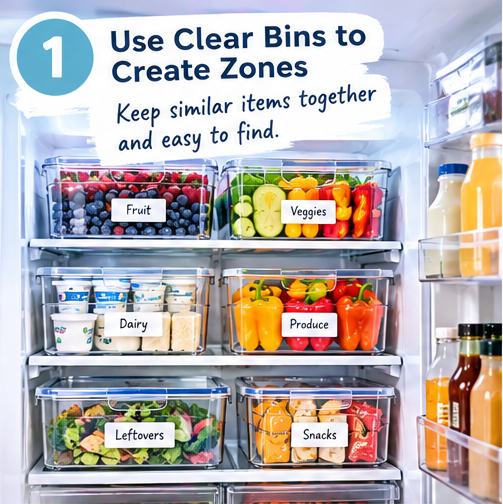
2. Use Clear Bins to Keep Small Items From Spreading
Small packages are some of the hardest refrigerator items to control.
Cheese sticks, yogurt cups, snack packs, butter, small produce, and similar items can quickly spread across an entire shelf.
Clear storage bins create a defined boundary.
Instead of placing individual items randomly across the refrigerator, group similar foods together in one container.
This also creates a useful pull-out zone. You can move the entire category forward rather than reaching behind several containers.
Best use for refrigerator storage bins
- Snacks
- Yogurt and dairy
- Small produce
- Breakfast foods
- Meal-prep ingredients
- Drinks
- Frequently used items
The key is not to fill every available inch.
Clear bins are particularly useful when you want to see what is inside without pulling everything out.
Best for: Creating refrigerator zones and keeping small food categories together.
3. Stop Losing Food at the Back of the Refrigerator
If you regularly discover food at the back of your refrigerator only after it has been forgotten, the problem is visibility.
A deep shelf can create a hidden second row of food.
You may see the items in front and completely forget what is behind them.
Instead of continually pushing food backward, create a system where frequently used items remain visible.
A clear bin can work particularly well for smaller items because you can pull the entire category forward.
For deeper shelves, avoid creating several layers of unrelated food.
A refrigerator organization system should make older food easier to see, not simply create more places to hide it.
4. Use a Lazy Susan for Bottles You Constantly Move
Condiments are another common source of refrigerator clutter.
A bottle gets pushed toward the back. Another bottle goes in front of it. Then you have to move several containers just to reach the one you want.
A Lazy Susan changes the problem from reaching to turning.
It works particularly well for groups of small bottles that are used regularly.
- Salad dressings
- Hot sauce
- Mustard
- Pickles
- Small jars
- Marinades
- Frequently used condiments
Don’t use one simply because it looks organized. Choose a Lazy Susan only where rotating the contents will genuinely make access easier.
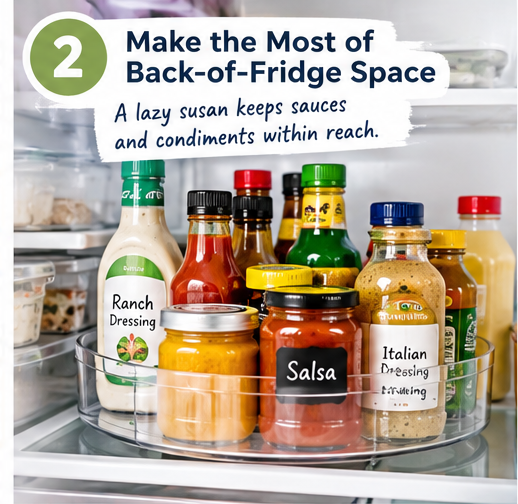
Best for: Sauces, dressings, jars, and bottles that are difficult to reach at the back.
5. Give Leftovers Their Own Refrigerator Zone
Leftovers often become refrigerator clutter because they don’t have a designated home.
One container goes on the top shelf. Another gets pushed into the back. A third ends up beside drinks.
After several days, it becomes difficult to know what needs to be eaten first.
Create a dedicated leftover zone instead.
The exact shelf depends on your refrigerator, but the principle is simple:
Leftovers should be easy to see, easy to reach, and easy to check.
Use containers that stack neatly when possible. This reduces the temptation to place containers wherever there happens to be space.
Remember that organization does not replace food-safety practices. Keep refrigerated foods at an appropriate temperature and follow current food-safety guidance.
6. Standardize Your Food Containers
A refrigerator can become difficult to organize when every food container has a different shape.
One round container wastes space beside two square containers. A tall container blocks shorter ones. A large container leaves an awkward gap that can’t be used.
You don’t need to replace every container in your kitchen at once.
Instead, gradually move toward containers with similar shapes and sizes.
Stackable rectangular containers are particularly useful because they make vertical space easier to use.
What to look for
- Stackability
- Visibility
- Consistent shapes
- Lid storage
- Appropriate sizes
- Ease of cleaning
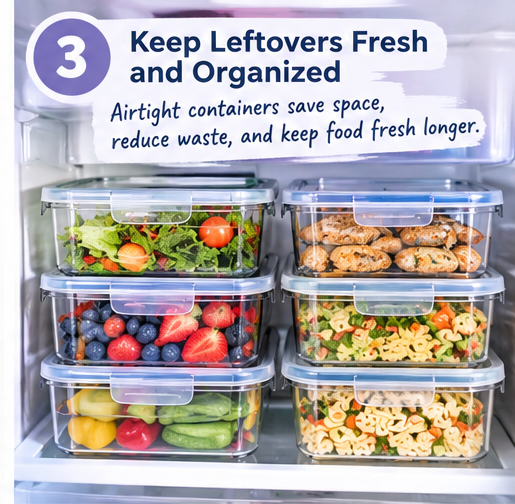
Best for: Leftovers, meal prep, and refrigerators where mismatched containers waste shelf space.
7. Make the Refrigerator Door Work Harder
The refrigerator door is convenient, but it can become one of the most cluttered areas.
Instead of treating every door shelf as general storage, assign simple categories.
- Condiments
- Drinks
- Sauces
- Frequently used small bottles
Keep the categories consistent so family members know where things belong.
However, don’t assume every food belongs in the door just because there is space there. Follow the storage directions for the food and your refrigerator manufacturer.
8. Put the Foods You Use Most Often at Eye Level
An organized refrigerator should reflect your daily routine.
If you make breakfast every morning, breakfast foods should be easy to reach.
If your family frequently prepares lunches, lunch ingredients should not be buried behind rarely used items.
Think about frequency of use, not just food type.
A simple system might be:
- Eye level: everyday foods
- Lower shelves: larger containers and meal prep
- Drawers: produce
- Door: suitable condiments and beverages
- Less accessible areas: less frequently used items
The exact arrangement depends on your refrigerator and food-storage requirements. The goal is to reduce unnecessary searching.
9. Create an “Eat First” Area
One of the easiest ways to waste food is to forget what needs to be eaten soon.
Instead of hiding older food behind newly purchased groceries, create a clearly visible Eat First area.
This can be a small bin or a designated section of one shelf.
Use it for food that you want the household to notice before opening something new.
- Opened packages
- Leftovers
- Produce that needs to be used soon
- Previously prepared meals
This isn’t a replacement for checking food safety. If you’re unsure whether food is safe, follow appropriate food-storage guidance rather than relying on appearance or smell alone.
10. Label Food When the Label Solves a Real Problem
Labels can be helpful, but labeling everything can create unnecessary work.
Use them where they reduce confusion.
This is especially useful for:
- Leftovers
- Meal-prep containers
- Prepared ingredients
- Similar-looking foods
- Shared family food
- An “Eat First” zone
A simple date or food name can answer a question before someone opens the container.
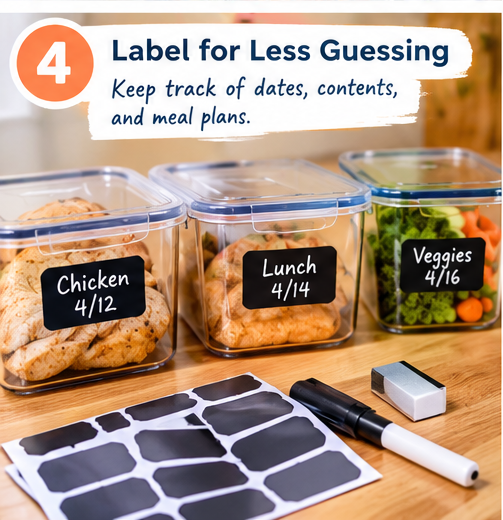
Best for: Leftovers, meal prep, dates, food names, and shared family storage.
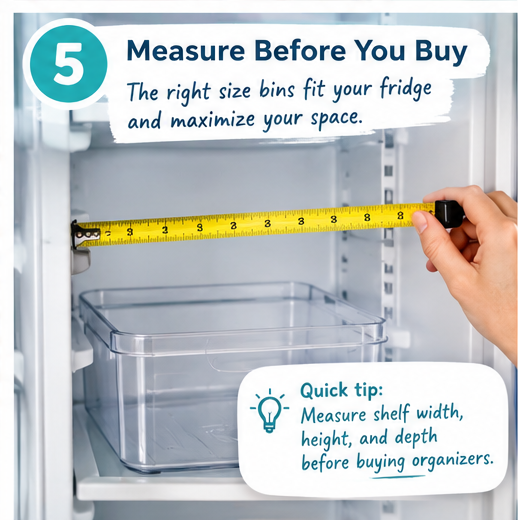
11. Measure Your Refrigerator Before Buying Organizers
This is one of the most important refrigerator organization tips — and one people often skip.
A storage bin can look perfect online and still be completely wrong for your refrigerator.
Before buying organizers, measure the space where you intend to use them.
Check:
- Width
- Depth
- Height
- Shelf clearance
- Door clearance
- Drawer clearance
Also consider how the organizer will be removed.
A bin that fits perfectly when stationary may become frustrating if you cannot pull it forward without hitting the shelf above it.
Measure first. Shop second.
This is particularly important for small refrigerators, apartment refrigerators, and refrigerators with unusual shelf layouts.
12. Don’t Fill Every Inch of Available Space
More storage containers do not automatically mean better refrigerator organization.
If you fill every gap, you can actually make the refrigerator harder to use.
- Food becomes difficult to see.
- Cleaning becomes harder.
- Removing one item may require moving several others.
- Cold air circulation can be restricted when the refrigerator is overpacked.
A little empty space is not wasted space.
It is working space.
13. Keep Raw Foods Separate From Ready-to-Eat Foods
Organization should also make safe food handling easier.
For refrigerator temperature, prompt refrigeration, avoiding overpacking, and other storage basics, see the FDA food-storage guidance.
Raw meat, poultry, and seafood should be kept separate from ready-to-eat foods, with attention to preventing juices from dripping onto other foods.
Use sealed containers or bags where appropriate and organize the refrigerator so raw foods cannot easily contaminate prepared food below them.
This means your refrigerator zones shouldn’t be based only on convenience.
Think about food safety as part of the organization system. A well-organized refrigerator should make safe storage easier, not just make the shelves look tidy.
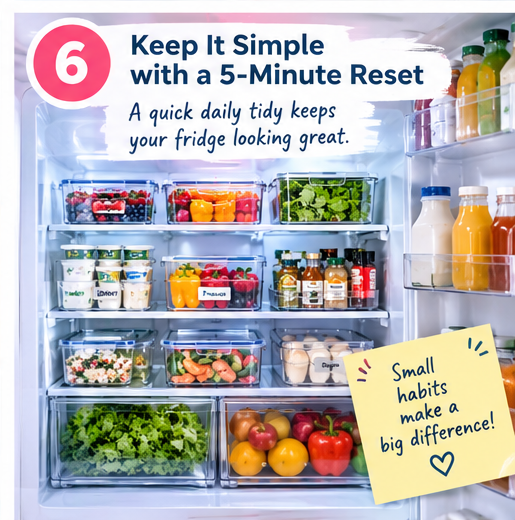
14. Create a Five-Minute Refrigerator Reset
The best refrigerator organization system isn’t the one that looks perfect immediately after a major cleaning.
It’s the one you can maintain.
Once or twice a week, take a few minutes to:
- Return misplaced items to their zones.
- Move older food toward the front.
- Check the leftover area.
- Wipe up spills.
- Remove food that should be discarded.
- Check whether any category has outgrown its space.
A short reset is much easier to maintain than waiting until the refrigerator becomes completely chaotic.
15. Build a System Your Family Will Actually Use
This may be the most important refrigerator organization idea of all.
A system that only one person understands will eventually fail.
If everyone in the household grabs food from the refrigerator, the organization needs to be obvious.
Don’t create complicated categories unless those categories genuinely help your household.
Simple categories are usually easier:
Drinks. Snacks. Leftovers. Produce. Dairy. Sauces.
The easier the system is to understand, the more likely people are to put things back correctly.
The real goal
- You can find what you need quickly.
- Older food stays visible.
- Leftovers have a clear home.
- Frequently used foods are accessible.
- Containers stack efficiently.
- Family members know where things belong.
- Cleaning doesn’t become a major project.
A Simple Refrigerator Organization Setup
If you’re starting from scratch, you don’t need to buy every type of organizer at once.
Start with the problem that causes the most frustration.
If small items keep spreading
Try clear storage bins.
If bottles disappear behind each other
Try a Lazy Susan.
If leftovers create container chaos
Standardize your food storage containers.
If nobody knows what’s inside a container
Try erasable food labels.
If organizers keep not fitting
Stop buying first and measure the refrigerator.
This approach prevents another common mistake: buying organizing products before deciding what problem they are supposed to solve.
4 Refrigerator Organization Products Worth Considering
| Product | Best for |
|---|---|
| Vtopmart Clear Storage Bins | Creating refrigerator zones |
| LAMU Lazy Susan Organizer | Bottles and condiments |
| Rubbermaid Brilliance Containers | Leftovers and meal prep |
| Jokari Erasable Food Labels | Dates, contents, and shared food |
You do not need all four.
Choose based on the problem your refrigerator actually has.
Final Thoughts
Good refrigerator organization is less about buying more storage products and more about creating a system that matches the way your household uses food.
Start with the biggest problem.
Create a simple zone.
Make frequently used food visible.
Use containers only where they solve a specific storage problem.
Measure before buying organizers.
Leave enough room for airflow and easy access.
If you use labels in several areas of your home, our guide to Bluetooth label makers for home organization can help you decide whether a label maker is useful beyond the refrigerator.
If you already have a pantry that becomes cluttered for similar reasons, you may also find our guide to Pantry Organization useful.
For households that use labels throughout the kitchen, our guide to How to Label Storage Bins can help you build a labeling system that extends beyond the refrigerator.
The goal isn’t a perfect refrigerator.
It’s a refrigerator that stays usable.